Topology
Study of properties preserved under continuous deformations.

Wikipedia / Wikimedia Commons
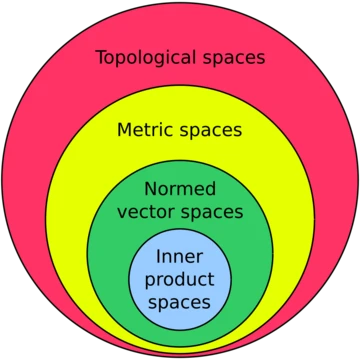
Topology is the branch of mathematics concerned with properties of geometric objects preserved under continuous deformations such as stretching, twisting, crumpling, and bending, without closing holes, opening holes, tearing, gluing, or passing through itself. A topological space is a set endowed with a structure called a topology, which allows defining continuous deformation of subspaces and all kinds of continuity; Euclidean spaces and metric spaces are examples of topological spaces.
- field
- Mathematics
- known_for
- Study of topological properties such as dimension, compactness, and connectedness; homeomorphisms and homotopies; the Seven Bridges of Königsberg problem; polyhedron formula V − E + F = 2
Lore & Background
The ideas underlying topology go back to Gottfried Wilhelm Leibniz in the 17th century, who envisioned geometria situs and analysis situs. Leonhard Euler's Seven Bridges of Königsberg problem and polyhedron formula are arguably the field's first theorems. The term topology was introduced by Johann Benedict Listing in the 19th century, though the idea of a topological space was not developed until the first decades of the 20th century.
Reader's Guide
Topology's significance lies in its ability to solve geometric problems that depend not on exact shape but on how objects are put together. For example, Euler demonstrated that crossing each of the seven bridges of Königsberg exactly once was impossible, a result depending only on connectivity properties. Similarly, the hairy ball theorem states that one cannot comb the hair flat on a hairy ball without creating a cowlick, applying to any smooth blob without holes. These insights led to the formalization of homeomorphism and homotopy equivalence. The development of topology in the 20th century included Maurice Fréchet's introduction of metric spaces in 1906, Felix Hausdorff's coining of 'topological space' in 1914, and Kazimierz Kuratowski's generalization in 1922. Modern topology depends strongly on set theory developed by Georg Cantor. The 2022 Abel Prize was awarded to Dennis Sullivan for his contributions to topology in its broadest sense.
Did You Know?
- The term 'topology' comes from the Greek words τόπος ('place, location') and λόγος ('study').
- Leonhard Euler's 1736 paper on the Seven Bridges of Königsberg is regarded as one of the first practical applications of topology.
- The surface of a coffee mug and the surface of a doughnut (a torus) are homeomorphic; a pliable torus can be reshaped into a mug by creating a dimple and enlarging it while shrinking the central hole into the handle.
- The 2022 Abel Prize was awarded to Dennis Sullivan for his groundbreaking contributions to topology.
Frequently Asked Questions
Who is Topology?
Topology is a branch of mathematics that examines which features of shapes survive when you stretch, twist, or crumple them without tearing or creating new holes. It treats a coffee mug and a donut as essentially the same object because both have exactly one hole.
What are Topology's core abilities?
Its main power is identifying invariants—properties like dimension, compactness, and connectedness—that remain unchanged no matter how continuously you deform a space. It also classifies how spaces relate to one another through homeomorphisms and tracks deformations via homotopies.
What is Topology's origin story?
The field traces its roots to Leonhard Euler's 1736 solution of the Seven Bridges of Königsberg puzzle, where he proved no walking route could cross each of the city's seven bridges exactly once. That problem is widely regarded as the first true topological argument in mathematical history.
What is Topology's most iconic signature move?
Euler's polyhedron formula, V − E + F = 2, which states that for any convex polyhedron the number of vertices minus edges plus faces always equals two. This relationship holds regardless of the polyhedron's specific shape, making it a cornerstone result in the field.
Why do fans consider Topology essential to the wider math universe?
It provides the general framework of topological spaces that lets mathematicians define continuity and deformation in settings far beyond ordinary Euclidean or metric spaces. Nearly every other area of mathematics, from analysis to algebraic geometry, relies on the language and tools topology introduces.
More in Topology And Abstract Spaces 1-24
Spotted an error? Know more?
This is a living reference — every entry is fact-audited, and reader corrections feed straight into our audit queue. Suggest an edit · See this site's audit record