Topological space
A set with structure defining closeness without distance.

Wikipedia / Wikimedia Commons
A topological space is a mathematical structure that defines closeness without requiring a numeric distance. It consists of a set of points and a topology, which can be defined via neighbourhoods or open sets, and is the most general type of space allowing definitions of limits, continuity, and connectedness.
- field
- Mathematics
- known_for
- Foundational concept in general topology (point-set topology)
Lore & Background
The concept of topological space was first defined by Felix Hausdorff in 1914 in his seminal 'Principles of Set Theory'. Metric spaces had been defined earlier in 1906 by Maurice Fréchet, who also introduced the term 'metric space'. The neighbourhood axiomatization of a topological space is due to Hausdorff.
The study of topology has earlier roots: around 1735, Leonhard Euler discovered the formula V−E+F=2 relating vertices, edges, and faces of a convex polyhedron. Work by Cauchy and L'Huilier boosted the study of topology. In 1827, Carl Friedrich Gauss published 'General investigations of curved surfaces', a foundational work in differential geometry, though it does not constitute a topological definition. The term 'topology' was introduced by Johann Benedict Listing in 1847.
Reader's Guide
Topological spaces are fundamental and used in virtually every branch of modern mathematics. They allow for the definition of limits, continuity, and connectedness in the most general setting. Common types include Euclidean spaces, metric spaces, and manifolds. The subject is clearly defined by Felix Klein in his 'Erlangen Program' (1872) as the geometry invariants of arbitrary continuous transformation. The foundation for spaces of any dimension was created by Henri Poincaré, with his first article on this topic appearing in 1894. In the 1930s, James Waddell Alexander II and Hassler Whitney expressed the idea that a surface is a topological space locally like a Euclidean plane. The utility of the concept is shown by several equivalent definitions, with the most commonly used being through open sets, though the neighbourhood definition is often more intuitive.
Did You Know?
- The term 'topology' was introduced by Johann Benedict Listing in 1847.
- Felix Hausdorff first defined topological spaces in 1914 in his 'Principles of Set Theory'.
- Around 1735, Leonhard Euler discovered the formula V−E+F=2 for convex polyhedra, which boosted topology.
- Henri Poincaré created the foundation of topology for spaces of any dimension, with his first major topology paper 'Analysis situs' published in 1895.
Frequently Asked Questions
What is a topological space?
A topological space is a set of points paired with a chosen family of 'open sets' that formalizes the idea of nearness without ever invoking a numerical distance. It is the broadest setting in which one can still meaningfully discuss limits, continuity, and connectedness.
What can a topological space do that a plain set cannot?
Once you attach a topology to a set, you gain the ability to define continuous maps, talk about convergence of sequences or nets, and separate connected structures from disconnected ones. None of these tools require a metric or any measure of 'how far apart' two points are.
How is a topological space different from a metric space?
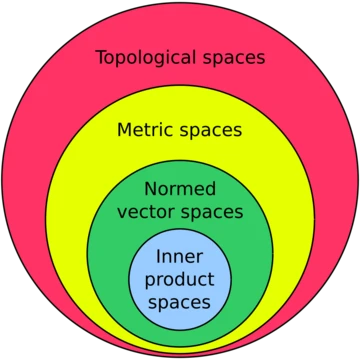
A metric space supplies a distance function that automatically generates a topology, while a topological space only demands a family of open sets satisfying three axioms: containing the empty and full sets, closed under arbitrary unions, and closed under finite intersections. Every metric space is a topological space, but many topological spaces admit no compatible metric at all.
Why is the topological space considered foundational in mathematics?
It provides the minimal structural framework needed to generalize results from calculus and analysis into settings where no coordinates or distances exist. Virtually every branch of algebraic topology, differential geometry, and functional analysis builds its core definitions on this single concept.
How do you actually specify a topological space?
You pick a set X and select a collection τ of its subsets (the open sets) such that the empty set and X itself belong to τ, any union of members of τ is again in τ, and any finite intersection of members of τ is in τ. Equivalently, one can define the topology by prescribing, for each point, the family of neighbourhoods it possesses.
More in Topology And Abstract Spaces 1-24
Spotted an error? Know more?
This is a living reference — every entry is fact-audited, and reader corrections feed straight into our audit queue. Suggest an edit · See this site's audit record