Manifold
A topological space locally resembling Euclidean space near each point.
In mathematics, a manifold is a topological space that looks like ordinary Euclidean space when you zoom in on any point. Specifically, an \(n\)-dimensional manifold (or \(n\)-manifold) is a topological space where every point has a neighborhood that can be mapped continuously and invertibly onto an open region of \(n\)-dimensional Euclidean space. One-dimensional examples include lines and circles, but not self-intersecting curves like a figure-eight. Two-dimensional manifolds are called surfaces; the plane, sphere, torus, Klein bottle, and real projective plane are all examples.
Manifolds are fundamental to geometry and modern physics because they let complex structures be studied using the well-understood properties of simpler spaces. They appear naturally as solution sets of equations and as graphs of functions, and they have practical uses in computer graphics, such as linking images to coordinates in CT scans.
Manifolds can carry extra structure. Differentiable manifolds allow calculus to be performed. A Riemannian metric enables measurement of distances and angles. Symplectic manifolds serve as phase spaces in Hamiltonian mechanics, while four-dimensional Lorentzian manifolds model spacetime in general relativity. Studying manifolds requires knowledge of calculus and topology.
A simple motivating example is the circle. Topology ignores bending, so a small piece of a circle behaves like a small piece of a line. Consider the top arc of the unit circle \(x^2 + y^2 = 1\), where \(y > 0\). Each point on this arc can be uniquely described by its \(x\)-coordinate, giving a continuous, invertible map from the arc to the open interval \((-1, 1)\). Such a map, together with its domain, is called a chart. Similarly, charts exist for the bottom, left, and right parts of the circle. Together, these four charts cover the entire circle, forming an atlas. The top and right charts overlap where both \(x\) and \(y\) are positive; each maps this overlapping region to \((0,1)\), but in different ways. The transition between these two charts is given by a function that relates the two coordinate descriptions.
- field
- Mathematics
- known_for
- Topological space locally resembling Euclidean space; central to geometry and modern mathematical physics
Lore & Background
One-dimensional manifolds include lines and circles, but not self-crossing curves such as a figure-eight. Two-dimensional manifolds are also called surfaces; examples include the plane, the sphere, and the torus, and also the Klein bottle and real projective plane. Manifolds naturally arise as solution sets of systems of equations and as graphs of functions, and have applications in computer graphics given the need to associate pictures with coordinates (e.g., CT scans).
Manifolds can be equipped with additional structure. One important class are differentiable manifolds, whose differentiable structure allows calculus to be done. A Riemannian metric on a manifold allows distances and angles to be measured. Symplectic manifolds serve as the phase spaces in the Hamiltonian formalism of classical mechanics, while four-dimensional Lorentzian manifolds model spacetime in general relativity.
After a line, a circle is the simplest example of a topological manifold. Topology ignores bending, so a small piece of a circle is treated the same as a small piece of a line. Charts, such as those mapping parts of the circle to intervals, together form an atlas. The study of manifolds requires working knowledge of calculus and topology.
Reader's Guide
The manifold concept is fundamental in mathematics and physics because it provides a rigorous framework for describing spaces that are locally simple but globally complex. By requiring each point to have a neighborhood homeomorphic to Euclidean space, manifolds allow the application of familiar tools like calculus and coordinate systems to curved or abstract spaces. This has profound implications: differentiable manifolds enable calculus on curved surfaces, Riemannian metrics introduce geometry with distances and angles, symplectic manifolds underpin classical mechanics, and Lorentzian manifolds model spacetime in general relativity. Manifolds also appear in applied contexts, such as computer graphics and medical imaging, where coordinates must be assigned to images. The circle example illustrates how charts and atlases work, showing that even a simple manifold requires multiple overlapping coordinate patches to cover it completely. The concept's power lies in its ability to unify diverse mathematical objects—from lines and spheres to Klein bottles—under a single definition, making it indispensable for modern geometry and theoretical physics.
Did You Know?
- One-dimensional manifolds include lines and circles, but not self-crossing curves such as a figure-eight.
- Two-dimensional manifolds are also called surfaces; examples include the plane, the sphere, the torus, the Klein bottle, and the real projective plane.
- Symplectic manifolds serve as the phase spaces in the Hamiltonian formalism of classical mechanics.
- Four-dimensional Lorentzian manifolds model spacetime in general relativity.
Frequently Asked Questions
What is a Manifold in topology?
A manifold is a topological space that, when you zoom in close enough around any single point, looks exactly like a patch of flat Euclidean space. In other words, every point has a small neighborhood that can be smoothly and reversibly matched onto an open region of R^n.
What are the classic examples of manifolds?
One-dimensional manifolds include the simple line and the circle, while two-dimensional ones (called surfaces) include the plane, the sphere, the torus, the Klein bottle, and the real projective plane. Each of these locally feels like flat paper no matter where you stand on it.
Why can't a figure-eight curve be a manifold?
A figure-eight self-intersects at a single crossing point, and no neighborhood around that crossing can be mapped continuously and invertibly onto an open set in R^1. Because that one point fails the local-Euclidean requirement, the whole curve is disqualified as a one-manifold.
Why do physicists and geometers care so much about manifolds?
Manifolds provide the natural stage on which smooth geometry and calculus can be performed without being locked into a global coordinate grid. This makes them the foundational setting for general relativity, gauge theory, and much of modern differential geometry.
How is a manifold different from an arbitrary topological space?
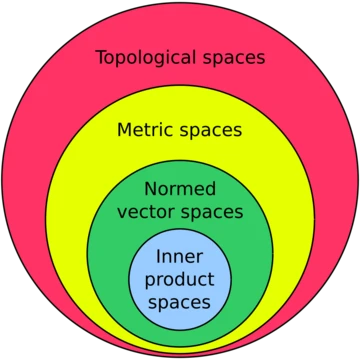
A general topological space only guarantees that open sets behave well under unions and finite intersections; it says nothing about local geometric shape. A manifold adds the much stronger demand that every point's neighborhood is homeomorphic to a piece of Euclidean space, giving the space a uniform, locally flat character.
More in Topology And Abstract Spaces 1-24
Spotted an error? Know more?
This is a living reference — every entry is fact-audited, and reader corrections feed straight into our audit queue. Suggest an edit · See this site's audit record